
AI product visuals at lower cost and faster turnaround.
AI product photography produces and edits your product visuals (packshots, lifestyle shots, variants) faster and at a lower cost than a traditional shoot. It is an emerging market where early positioning pays off. We connect the visuals to your DAM and catalog.
A real person replies within 24 business hours.
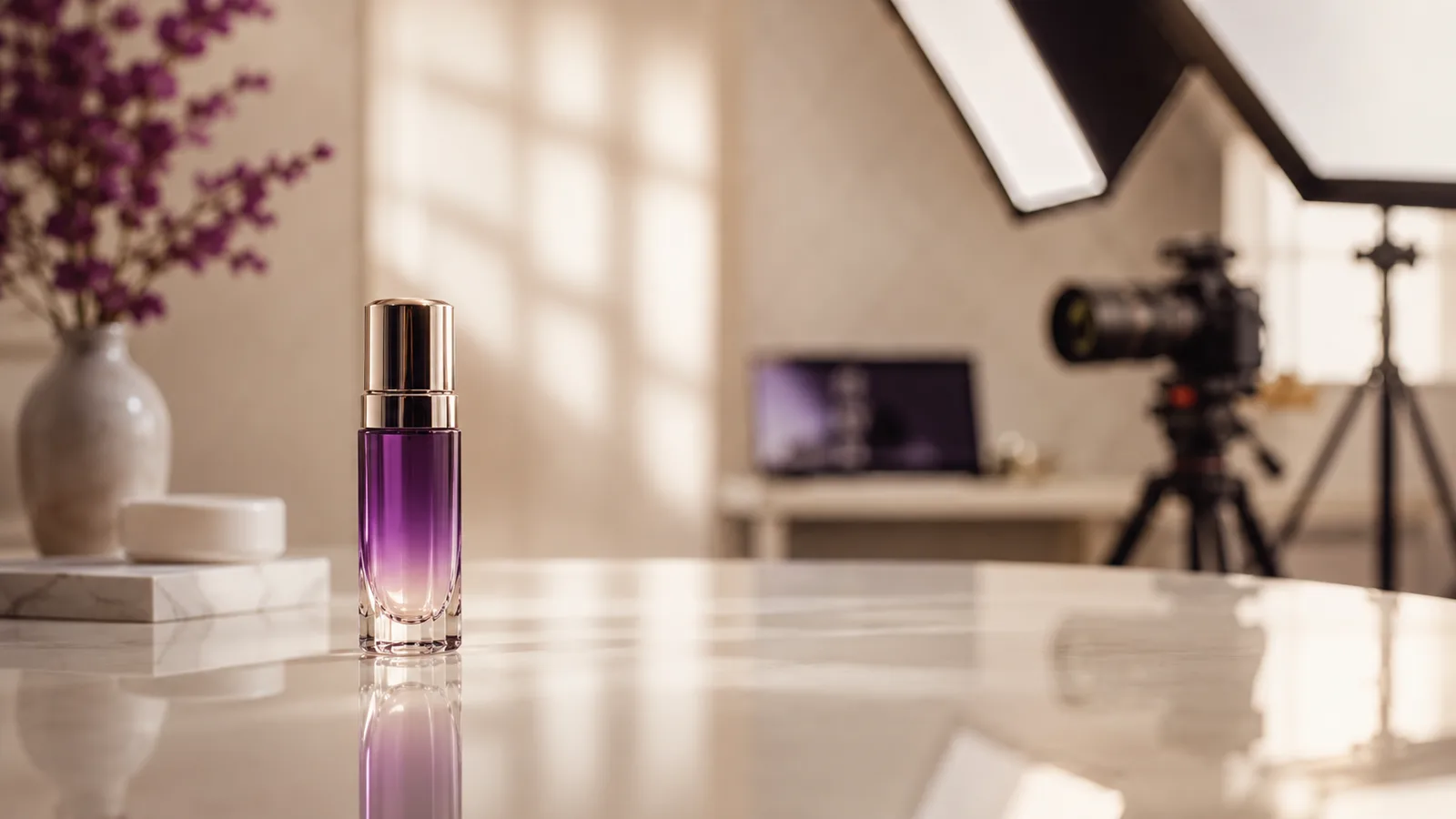
Your product shoots are expensive, take time, and you never have enough variant visuals for all your channels.
A fast visual production pipeline: AI-generated packshots and lifestyle shots, edited, and distributed to your catalog.
Benefits
Product visuals delivered faster
Lower cost per visual
Easy variants (formats, backgrounds, scenes)
Direct distribution to the DAM
Deliverables
Style and brand visual guidelines
AI generation and editing
Multi-format variants
DAM and e-commerce integration
Use cases
Large catalogs
Recurring product launches
Marketplaces
Social media and paid advertising
AI product photography and AI packshots now make it possible to produce professional-quality commercial visuals without a physical studio. For e-commerce brands managing catalogs of hundreds or thousands of SKUs, the reduction in visual production cost and lead time is measurable and significant. This guide covers productive use cases, real limits, and the criteria for choosing the right workflow.
AI product photography: what the technology enables in 2026
Image generation models (Midjourney, Stable Diffusion, Firefly, Flux) have reached a quality level sufficient for standard product photography: packshots on white or colored backgrounds, simple lifestyle shots, color variant generations. For these use cases, AI product photography replaces a traditional studio for 70 to 80 percent of a fashion or beauty brand's catalog.
What the technology still does not handle reliably: very specific textures (grained leather, precise metallic reflections, transparencies), products with fine readable details (typography on packaging, legal labels), and advertising formats requiring strict brand consistency across multiple visuals. Those categories are still better handled by a photographer.
Comparison of AI packshot workflows
| Workflow | Use case | Cost per visual | Production time | Main limitation |
|---|---|---|---|---|
| AI background removal + cropping | Fast white-background packshot | 0.05 to 0.20 EUR | 2 to 5 min | Variable quality on complex edges |
| Background generation and lifestyle staging | Product lifestyle without a studio | 0.50 to 2 EUR | 10 to 20 min | Consistency across visuals |
| Automated color variant generation | Color variants of the same product | 0.20 to 0.80 EUR | 5 to 15 min | Requires a quality base product image |
| Virtual mannequin (fashion) | Presentation on a silhouette | 1 to 5 EUR | 20 to 40 min | Limited proportions and naturalness |
| Full AI virtual studio | Premium packshot with lighting | 2 to 8 EUR | 30 to 60 min | Human supervision required |
AI product photography in an e-commerce workflow: a typical architecture
For a brand with a continuous flow of new products, the optimal architecture combines several automated steps: ingesting the raw product photo, removing the background, normalizing the crop, generating lifestyle variants, automated quality control (artifact detection), and injecting the result into the product data system or media manager. One person validates the batch once a day rather than processing each visual individually.
Quality criteria and human validation
An AI product photography workflow without human validation will inevitably produce artifacts that make it online. The best practice is to attach a confidence score to each generated visual: visuals below the threshold are sent for human review, others are published automatically. That filter reduces validation workload by 80 percent while maintaining quality.
The most common errors to watch for: distorted hands and fingers on visuals with a mannequin, unreadable text on packaging, inconsistent lighting across elements of a lifestyle scene, and edge artifacts after background removal. A codified quality-control checklist helps validators process batches quickly.
ROI and comparison with traditional studio
A traditional studio shoot for 50 SKUs with variants (white background plus 2 lifestyle setups) costs between 3,000 and 8,000 euros, with a delivery lead time of 5 to 10 days. The same volume through an AI workflow runs 300 to 1,500 euros with a turnaround of 24 to 48 hours. The gap is significant for brands that regularly launch new collections or need fast variant generation.
The traditional studio remains relevant for brand campaigns, hero visuals, and packaging with legal display requirements. The AI workflow is optimized for the current product catalog, color variants, and secondary visuals. The two coexist in most mature organizations. For catalog management workflows that reference those visuals, the gains compound.
Are AI-generated visuals accepted by marketplaces?
Yes, for the vast majority. Amazon, Cdiscount, and the main comparison engines accept white-background packshots whether produced in a studio or by AI, as long as dimensions and technical requirements are met. Certain categories (cosmetics with mandatory labeling, food with regulated visuals) require photos that comply with legal specifications, which calls for more thorough validation.
Do you need a professional photographer to feed the AI workflow?
No, but the quality of the source photo determines the result. A sharp, evenly lit raw photo with a contrasting background produces a significantly better output than a blurry or overexposed one. A basic photography guide for the logistics or sales team that photographs products is enough in most cases.
Can you automate mass production for a catalog of 500 products?
Yes. An n8n or Make workflow orchestrates the ingestion of raw photos from a shared folder or DAM, triggers API calls to the generation service, retrieves the visuals, tags them, and injects them into the PIM or Shopify. With a well-configured flow, 500 visuals are processed overnight. Human validation is done on a sample and on cases flagged by the confidence score. Discuss your project to assess your catalog's specific requirements.
Before we start.
Is the quality on par with a studio shoot?
For packshots and many lifestyle setups, yes. For highly artistic visual concepts, a traditional shoot is still the right call, and we will say so.
Can the visuals be used commercially?
Yes. We define rights and usage terms at the start of the project.
Business Automation and AI
Business Process Automation
Make and n8n workflows to eliminate re-entry and repetitive tasks.
Learn moreAccounting, Finance, and Purchasing Automation
Automated invoice collection, reconciliation, and accounting exports.
Learn moreSupplier Purchasing Automation
Automated purchase requests, approvals, and supplier orders.
Learn moreContent-to-Commerce
Connecting content and your store to turn your audience into sales.
Learn moreSales Automation
Contact enrichment, sequences, and lead routing connected to your CRM.
Learn moreA ai product photography and visuals project to scope?
Send us your context. We tell you where to start, because a well-chosen first project saves you from paying for the rest too early. A real person replies within 24 business hours.