
Automations that remove manual work without making you lose control.
We connect your tools and automate repetitive tasks, from back-office work (accounting, purchasing) to e-commerce (product visuals, content) and sales. Every automation stays documented and monitored: you save time without losing control.
A real person replies within 24 business hours.
Business Automation and AI in detail.
Make, n8n, and AI automations to eliminate repetitive tasks, from back-office to product visuals.
Business Process Automation
Make and n8n workflows to eliminate re-entry and repetitive tasks.
Learn moreAccounting, Finance, and Purchasing Automation
Automated invoice collection, reconciliation, and accounting exports.
Learn moreSupplier Purchasing Automation
Automated purchase requests, approvals, and supplier orders.
Learn moreContent-to-Commerce
Connecting content and your store to turn your audience into sales.
Learn moreAI Product Photography and Visuals
AI-generated and edited product packshots and lifestyle images.
Learn moreSales Automation
Contact enrichment, sequences, and lead routing connected to your CRM.
Learn more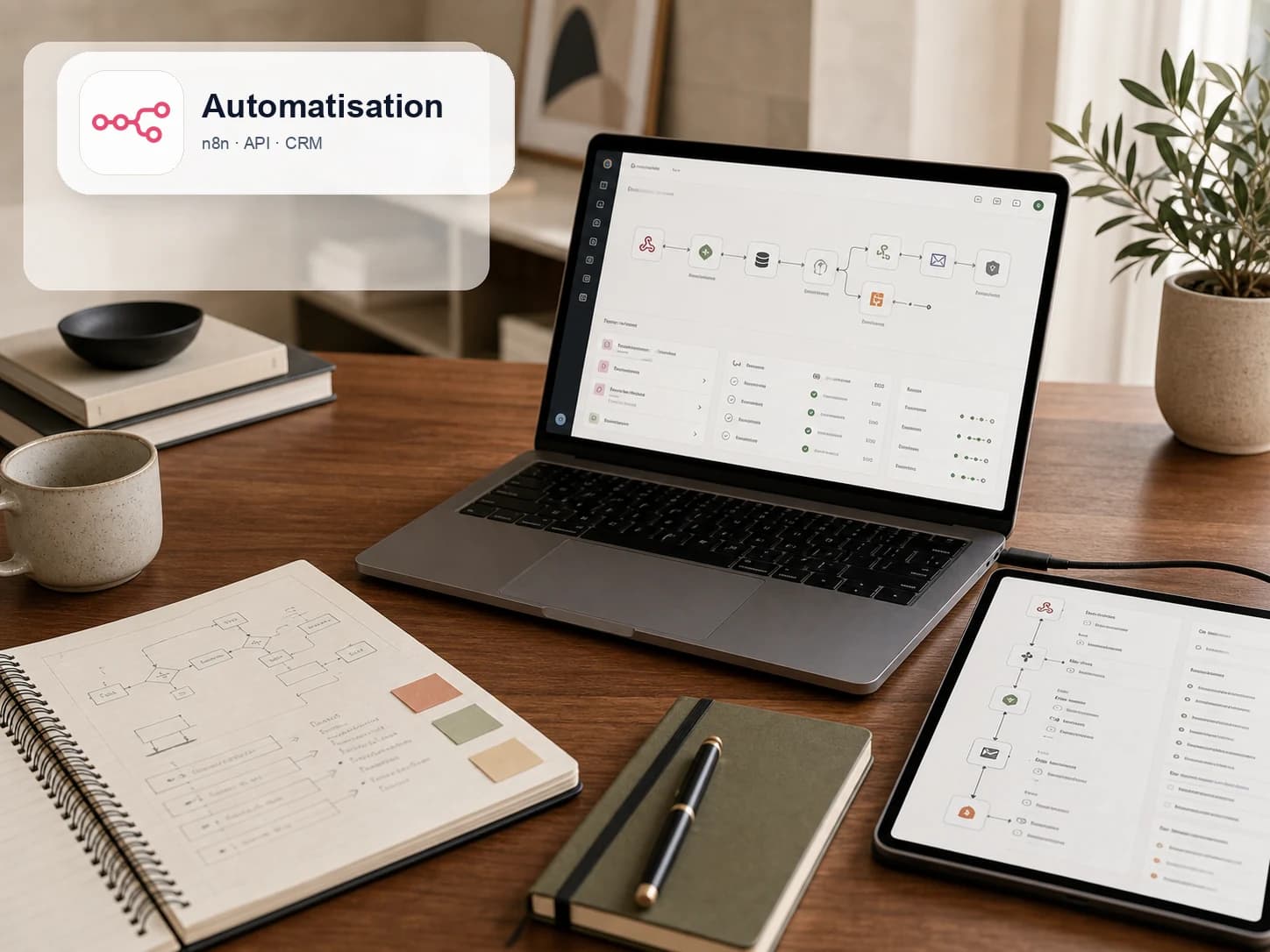
You reduce manual work without losing control. Every automation stays documented and monitored.
Benefits
Hours recovered every week
AI assistants governed by your business rules
Reliable API integrations
Human oversight on every workflow
Deliverables
Task audit and process mapping
Make, n8n, or Zapier workflows
AI assistants and API integrations
Documentation and monitoring
Use cases
Business process automation
Accounting, finance, and purchasing
AI product visuals
Sales prospecting
Your teams copy data between systems, handle the same requests over and over, and lose hours on repetitive tasks.
Smartshift builds automations and AI assistants (Make, n8n, Zapier, API integrations) to connect your tools and reduce repetitive tasks, from back-office to product visuals, with human oversight.
AI automation is not a lab exercise. It is an operational lever that SMBs and mid-market companies use today to handle in minutes tasks that used to consume several hours a week. Smartshift helps businesses set this up properly: identifying priority processes, choosing the right tools, maintaining human oversight, and staying GDPR-compliant.
In January 2025, 31 percent of French small and mid-sized companies were already using generative AI, up from 3 percent of regular usage in late 2023, a tenfold increase in a single year (source: Bpifrance Le Lab, 2025). And 58 percent of executives now see AI as a matter of survival within three to five years. The real question is no longer whether, but which processes to automate first, and how to keep humans in the loop.
What AI automation actually covers for a business
A serious AI agency does not sell AI for the sake of AI. It starts from the operational problem: how many hours per week are consumed by repetitive tasks? Which processes are blocking growth? Where does manual data entry introduce costly errors? The answers to those questions determine whether an AI agent delivers measurable value or is a premature investment.
The most production-ready scenarios in 2026 fall into four broad categories: business process automation (data flows, notifications, cross-tool coordination), accounting and finance automation (reconciliation, follow-ups, reporting), procurement automation (qualification, tracking, comparison), and sales automation (outbound, qualification, pipeline tracking). Each has its own dedicated page in this guide.
AI agents vs. automation: what is the difference?
An automation workflow executes a predetermined sequence: if the form is submitted, send an email, create a record in the CRM, notify Slack. An AI agent does more: it reads a document, understands it, makes a contextual decision, and acts on it. That distinction matters when setting expectations and budgets.
In practice, most productive projects combine both. Tools like n8n or Make orchestrate the flows; a language model steps in on the steps that require understanding or generation. This architecture keeps human oversight at the center: the agent proposes, a person validates exceptions, and logs are retained.
| Scenario | Type | Average observed gain | Implementation complexity |
|---|---|---|---|
| Automatic client follow-ups after unpaid invoice | Simple automation | 3 to 5 h/week | Low |
| Classification and routing of incoming emails | AI agent | 5 to 8 h/week | Medium |
| Meeting summary generation | AI agent | 2 to 4 h/week | Low |
| Bank reconciliation and matching | Automation + AI | 4 to 6 h/week | Medium |
| Inbound lead qualification | AI agent | 6 to 10 h/week | Medium |
| Supplier tracking and order follow-ups | Simple automation | 2 to 3 h/week | Low |
How Smartshift structures an AI automation project
Every engagement starts with a two-day audit: mapping existing processes, estimating time consumed per task, and identifying tools already in place (CRM, ERP, accounting, messaging). That audit produces a backlog ranked by value and feasibility, which forms the basis for scoping. You can read more about our method on the dedicated page.
We systematically work with self-hosted infrastructure when data is sensitive. n8n deployed on your infrastructure or ours ensures your data never passes through third-party servers. That is a non-negotiable GDPR compliance point for processes that touch finance, clients, or HR.
- Process audit: identifying repetitive tasks and estimating potential time savings (Day 1 to 2)
- Prototype: first functional workflow on the simplest high-impact use case (Week 1 to 2)
- Testing and oversight: validating agent outputs on a real sample before going live (Week 3)
- Phased rollout: production deployment with alerts on exceptions and a full log
- Team training: getting your team comfortable with dashboards and modifying workflows without code
Limits and risks to plan for
An AI agent makes mistakes. Not often, but it does. A well-designed workflow always includes an oversight loop: ambiguous cases are flagged for human review rather than processed silently. That principle prevents silent errors that go unnoticed for weeks.
The second risk is tool dependency. Automating on a platform where you do not control the source code exposes you to pricing changes or policy shifts. That is why Smartshift favors open-source n8n and exportable architectures, with enough documentation for your team to maintain workflows without us. Browse our work to see concrete examples from past projects.
How much does an AI automation project cost for an SMB?
A well-scoped first project (one or two workflows, audit included) runs between 3,000 and 8,000 euros. Broader projects covering multiple departments and requiring ERP or accounting integrations fall between 15,000 and 40,000 euros. ROI is measured in hours saved: a gain of 10 hours per week at 50 euros per hour represents 26,000 euros per year.
Do you need to replace your existing tools to automate?
No. Orchestration tools like n8n or Make connect to existing tools through their APIs: Gmail, Outlook, Salesforce, HubSpot, Notion, Airtable, Stripe, Pennylane, Sage, and others. The initial audit identifies available connectors and any custom development needed for less standard tools.
Who monitors the AI agents once they are in production?
Your team, using simple dashboards. Each workflow produces a viewable log: inputs, outputs, exceptions. Cases the agent cannot handle are sent for human review by email or Slack notification. Smartshift trains one internal point of contact and remains available for updates or corrections.
“Automation is not a tooling topic. We look for the hours lost every week, what they cost, and we only plug in AI where it pays for itself.”

Founder of Smartshift
Frequently asked questions.
Where do we start?
With a concrete pain point: manual re-entry, a qualification step, a report. We prototype on a real use case before scaling.
Make, n8n, or Zapier?
Zapier for simple automations, Make for visual multi-step workflows, n8n for self-hosting and GDPR compliance. We choose based on risk, volume, and maintainability.
Can we automate without exposing sensitive data?
Yes, if the scope is defined upfront: access permissions, tools, authorized data, and human oversight are all specified before any deployment.